Climber.Org logo

Desert Peaks List


Search and Navigate  |   Trip Reports  |   Trip Announcements  |   Driving Directions
Reference Data  |   Roster  |   Message Board  |   Gear  |   Common Sense Rules!

ADDITIONS, UPDATES AND CORRECTIONS WOULD BE APPRECIATED!
To report errors, or to add more peaks to the list, please contact Steve Eckert.

TABLE OF CONTENTS:

click here to view regions
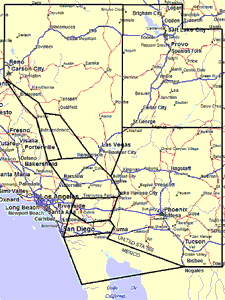
  • Desert Peaks Map displays regions graphically
  • list of DPS regions (each with links to GPS waypoints, region maps, etc)
  • sorted list of all Desert peaks (with links into the per-region pages)
  • Sierra Nevada Peaks are in a similar database
  • statewide peaks database for CA, CO, NV, OR, and WA (2000 peaks per state)
  • UTM and LAT/LON coordinate explanation
  • revision history and contributor credits
  • Waypoint data is shown in Waypoint+ format - copy and paste into a local text file, then read it into Waypoint+ or TOPO!. Even if you don't have a GPS receiver, use the waypoints in the regional peak listings to jump to peak locations in TOPO!. Each region is shown as an outline, and bookmarks help you find them before or after you overlay the regions with GPS coordinates to locate the peaks. NEW IN 2007: From each regional page, you can view that region overlaid with roads and trails on satellite images or maps using Google Maps (web application) or Google Earth (must download and install).

    If you follow the links below down to the peak details, you will find links to photos for many of the peaks, or you can jump to Karpel's Peak Pictures. Also with the peak details, there are links to TopoZone where you can view scalable online topo maps showing the peak location.

    Richard Carey has lots of data on these and other peaks, and his SPS and DPS sections are good places to start browsing.

    The Vulgarian Ramblers maintain a list of all CA 13ers, based on the best available USGS field survey and DEM data. For more details on DEM data, see the "Some Notes on Data Accuracy", "Column Descriptions and Color Usage", and "Even More Technical Information" sections of their web page.


    INTRODUCTION AND OVERVIEW

    This list was prepared as a convenient reference to many of the major peaks of the southwestern desert, by combining the official DPS Peaks List (published by the Desert Peaks Section, Angeles Chapter, Sierra Club) and some corrections and extra data (like all the waypoints) from Gary Craig, plus a bunch that I may add because I've been there or someone asked me to add them. It is hoped that this list will aid people both in choosing a peak to climb and in planning the trip.

    IN GENERAL, "EMBLEM" peaks dominate the area by their bulk or the amount of terrain that can be seen from the summit, but since there are only seven of them the criteria aren't always clear. Obviously, there are worthy climbs not on this list - and there are also peaks on this list that have trails to the top! The peaks are grouped into 9 geographical areas. The names of the 7 emblem peaks are marked with 'E' between the region number and the peak name in the regional listings. Peaks not on the official DPS list are labeled with 'XX' so they can be found and deleted to recover the official DPS Peaks List.

    The climbing class (difficulty rating) indicates the difficulty of the easiest route on the peak, but this is not necessarily the most commonly climbed route. The classes are summarized here, but a detailed description of ratings is online:


    UTM AND LAT/LON COORDINATE EXPLANATION

    UTM (Universal Transverse Mercator) coordinates are useful for specifying locations on a map: peaks, campsites, or points on a climbing route. The UTM grid is defined by fine black lines on recent maps and by blue tick marks along the edge of older maps. The lines are one kilometer apart and have a two digit identifying number.

    A location to the nearest 100 meters is given by a six digit number. The first two digits are the eastward coordinate obtained from the top or bottom edge of the map and the third digit is the number of tenths of a kilometer to the east of the grid line. The fourth and fifth digits are the northward coordinate obtained from the left or right edge of the map and the sixth digit is the tenths of a km to the north of the grid line. For example Cartago Peak (012203) is about 200 meters (third digit) east of the north-south grid line that is numbered "01" on the map edge and about 300 meters (sixth digit) north of the east-west grid line that is numbered "20" on the map.

    A location can be given to a precision of 10 meters by using an eight digit number where the third and fourth digits and the seventh and eighth digits give the fraction of a km to one percent. For example, Cartago Peak is the highest rock pile out of several nearby; its location to a precision of 10 meters is 01152033.

    A memory aid for the order of the digits is "read right up", i.e. eastward then northward.

    Latitude and Longitude (in degrees) are equivalent to UTMs as representations of location, but since the 'size' of a degree varies with location some people prefer UTMs when they are interpolating their position on a paper map. Some software mapping tools cannot read or write UTMs, so the data below is available in both formats.

    The amount of error between the datum used for drawing most UGSG maps (NAD27) and the datum used by GPS satellites (WGS84 is essentially the same as NAD83) varies with location. In places the difference between NAD27 and NAD83 datum is about a tenth of a mile or 100 meters. Authoritative details of how to convert between NAD27 and NAD83, including charts of how much difference there is between them as a function of location, can be found on the US National Geodetic Survey's NADCON page. Be sure your maps and/or software are using the same datum, or use software like Waypoint+ or TOPO!GPS to convert. The data in THIS file has the datum specified with the waypoints! Assume nothing!