Text and Photos by Timothy Hult Version 2.1, August 2006
Copyright (c) 2006 by Timothy D. Hult - all rights reserved - published on Climber.Org with author's permission
Table of contents:
1 Preface to the Second Edition *
1.2 Suggested climbing strategy *
1.2.1 Potential summit schedule from 14k *
1.3 Are you ready for Big Mac? *
1.6 When to go and how long to budget *
3.2 Radios, Cell Phones and FSRs: *
3.2.2 FSR (Family Service Radios "Talk abouts") *
3.2.4 2m Single Side Band Radio. *
3.3.1 Problems with Gas Stoves *
3.4 First Aid kit and Medical training: *
4 What I don't think is very useful: *
5.1.1 What I wore lower on the mountain. *
5.3.2 Some food suggestions: *
6.3 To shave or not to shave: *
10 Denali will kill you (Disclaimer) *
List of Figures
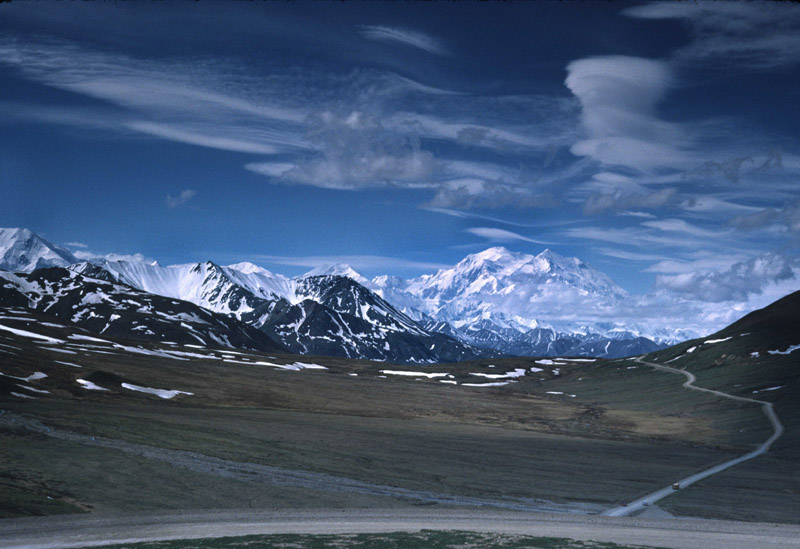
Cover Photo: Mt McKinley from the Denali Park Road
Figure 1 Around Windy (Icy!) Corner at 13,000 ft. Note the background storm clouds *
Figure 2 Snowshoeing up through a snowstorm at 10,000 feet *
Figure 3 The successful 2005 "3-D" Team on top of McKinley 20,320 ft *
Figure 4 14,000 foot Camp Snow Walls, Clouds and Mt Hunter *
Figure 5 Equipment stash at 14,000 ft *
Figure 6 Tim Skiing up the Kahiltna 9,500 ft *
Figure 7 Joe Working Cross word puzzles at 17,200 ft *
Figure 8 Joe Burton in his Big Down 40 deg Sleeping Bag *
Figure 9 Scott Warner hefts a load at 8,000 feet *
Figure 10: Scott Warner Starts out with Way too much weight 2005 *
Figure 11: Scott Warner Practicing crevasse self-rescue on a training trip *
Figure 12 Mount Hunter from 8,000 ft Camp *
Figure 13: Skiing up the lower Kahiltna in a white out *
Figure 14: The Rescue Helicopter comes to 14,000 ft for someone who lost their mittens (and later all their fingers) - 2005 *
Figure 15 Tim's Kit on Summit Day *
Figure 16: Going Down to pick up a Cache from 14,000 ft Camp. Mt Foraker in background *
Figure 17: Climbers moving up from Windy Corner at Dusk & Mt Foraker *
Figure 18 Joe Burton Prepares a Meal at 11,000 ft *
Figure 19: Day One Pulling The Full load out of 7,000 ft *
Figure 20: Typical unbalanced sled position *
Figure 21: Freezing Fog on the Lower Kahiltna Glacier *
Figure 22: Moving Up The West Buttress in Foggy Weather (15k 16,000 ft) *
Figure 23: Joe Burton Disposing of the Poo Bag in the Crevasse at 11,000 ft *
Figure 24 Steve Shields takes at "bath" at 11,000 ft *
Figure 25: Denali from 8,000 ft, NE Fork of the Kahiltna (foreground), West Rib (middle), and 20, 320 ft Summit *
Figure 26: Clouds "spill" over Kahiltna Pass at 11 PM: 12, 000 ft *
Figure 28: The "ants" march up the West Buttress from 14,000 ft on a good weather day *
On June 6, 2005, the sixteenth day of my third attempt, 3 teammates and I summited Denali all 20,320 ft of it. In doing so, I now have an answer to the question I often get from non-climbers: "what is the hardest mountain you've ever climbed?" In this second edition of my "notes" I've included as many of the lessons I learned on that third trip that I could think of, especially the impact of newer clothes, techniques, and the importance of the old lessons of safety.
This essay / check list / opinion piece is designed to answer the many questions I've gotten over the last several years concerning my experiences during all three of my attempts on McKinley / Denali in 1989, 1997 and finally a successful 2005 expedition. It is a discussion of my experiences on the mountain, and a checklist of things I'd bring again. Mostly, it's a set of rambling opinions, NOT intended as advice, so much as a telling of my adventures in one of the most starkly beautiful places I've been in a way other climbers may find more useful than a simple narrative. Of course, Climbing is inherently a dangerous, and an attempt on McKinley should be made with the full knowledge that climbers die on the peak every year. But McKinley is in a special category that not even Everest can be placed in: those peaks that are mentally difficult to climb. For while the technical difficulties aren't huge, the objective hazards are real, sustained and inescapable for the entire time you're on the mountain. Unlike Everest where parties shuttle up and down the mountain from the relative comfort of a base camp equipped with satellite phones, pizza, extra thick "luxury" Therm-a-rest mattresses, 3 person tents with a single occupant, and a well worn trail leading home that's devoid of objective danger one that a person can walk in 3 days while staying in "tea houses," drinking beer, eating potato chips and taking terrific pictures of exotic people and places all along the way - no such amenities or escapes (physical or mental) exist on McKinley. Any attempt should be made with the knowledge that Denali is a serious mental challenge. It is not a mountain that allows the near cavalier attitude: "I've done the Mexican Volcanoes, I can do this." Denali is a serious mountain that will tax your mental and physical stamina, your mountain-craft, and your tolerance for discomfort. Once you are on the mountain the only way off is to either wait for good weather to fly off, or to walk for 10 days through incredibly difficult terrain. To gage just how staggering this masiff is, consider what one of the glacial pilots told me: "in just about every guided party of 10 or more I've flown onto the mountain, at least one person gets off the plane and 10 minutes later gets right back after experiencing first hand what a vast place this is." These would be McKinley climbers experience the certainty that once the plane takes off, and they've strapped on your skis, they are committed no Cokes, no fast food, no repair shops, no MTV, nothing but what you carried on your back, their (or their guides') experience, and their own internal fortitude.
Finally, this essay should not be your only source of information. Read other sources, surf the web, talk to climbers that have done it, read the park service web site, and finally listen to the rangers' briefing in Talkeetna. Then search your soul and ask yourself if you really want to spend three plus weeks of physical and mental deprivation for the 50% chance of standing on top of N. America. Or would you rather spend 3 weeks in the Costa Rican Cloud Forest; or climb all three Mexican volcanoes and chug Negro Modelos in Publea; hike the Inca Trail and wait at the Sun Gate to enter Macchu Pecchu at dawn; or trek to Everest Base camp over three weeks through the Kumbu region in Nepal. If all else fails and you decide that this isn't the kind of trip you thought it was after listening to the ranger in Talkeetna, then jump on the bus in Denali park and take the ride out to Wonder Lake for the wildlife experience of a lifetime.
In the interest of full disclosure, I need to tell the reader that while I've been to McKinley 3 times, I've only summited once, and accomplished that feat only after a sustained push with an excellent team who managed to find a weather hole for our perfect summit day after waiting 3 days at the 17,200 ft high camp in temps that dipped to 25 deg F. We were lucky, For a week after we summited, the weather was lousy and no one made it. On my '97 attempt my partner Steve Eckert did manage to summit in a single, one-day heroic effort from our camp at 14,000 in Genet Basin after I fell ill with the flu after the carry to 17.2k. In my first attempt in '89, I got to 18k on the West Rib before bad weather forced us to retreat when our food ran out after a 3-day storm and powder snow to our waist made it impossible to continue upward. Overall, I've spent some 9 weeks living on the ice and snow of the great peak and feel you may benefit from my experiences.
A preamble comment before we begin. Climbing McKinley requires the successful party to be not only fit, but also logistically prepared, and internally harmonized. Climbing the mountain using guidebooks is a really good way to become acquainted with what to expect on the peak, but is not a substitute for practice and deep group discussion about schedules, alternatives, group dynamics and plain old human understanding. Making lists of food, equipment, potential schedules, and talking through the options will make it possible for you to do this peak. "Showing up and doing it," doesn't give the best odds for success.
This essay is arranged in a free-associated list of topics, interspersed with equipment checklists and some interesting stories. I hope you enjoy it and find it useful.
Anecdote: Which is Harder Everest or McKinley?
In 2005 we met a 46-year-old, solo Vancouver (Canadian) climber on his 4th, 5th or 6th trip to Denali. He was in really good shape and well acclimatized as witness by his one-day solo push with all his gear from the landing zone to the 11k camp (this spot usually takes 3 5 days to arrive at after multiple carries). His acclimatization was probably the result of is ability to pursue his mountaineering passion to a degree most of us can only dream of as he had been on guided trips to Everest several times (typically at $60,000/trip), making it to the top at least once. "Doing Denali" was something of a hobby for this guy and he knew the mountain well. Given his Everest experience, everyone in camp asked him how the two "emblem mountains" compared. He claimed Denali was harder as the physical effort to climb it was more difficult and sustained. While Everest was higher, and the need to use Oxygen very real there, all the climbs he had been on were supported by Sherpas, who carried all the gear except personal gear up the peak, and coached climbers up the hard bits. While on Denali, it was both colder for longer periods of time, and climbers had to do all their own work to get to the top. By the way, he made the top of Denali in 10 days (very, very fast by most measures), and if memory serves it was his 4th time to the top.
For more reading on this topic see: http://www.americanalpineclub.org/docs/HueyEverestAAJ_03.pdf
It snows a lot on Denali. It snows all the time on Denali. Sudden, blinding snowstorms blow up at least once a week and may last for days. When it snows hard, you or one of your tent mates will have to get up every two hours and dig the tent out in order to keep the air circulating around it least you suffocate. There are times that you WILL get caught in a storm so severe you'll have to make camp right where you stand. Sometime during your climb it will snow and be nasty. When it does, you won't be able to just head for the cars. You're there for the duration. You have to stick out some of the worst weather on the planet in nothing but a thin tent and a warm sleeping bag. Be prepared.
In my time on the mountain, I've learned that the weather may be divided into two zones: weather below 14,000 ft and the weather above 14,000 feet. Generally, the weather above is generally better as a rule (less foggy soup than down below), but worse when it is bad (much higher winds and way colder up high). Hence, it is not uncommon for it to be snowing at 11k, and sunny at 14 and above. It is also not uncommon for 2 feet of snow to drop overnight, or even during the day. Several times, I've been in storms requiring someone to shovel out the tent every 2 hours lest it be buried (surprisingly, this did not happen in 2005). I've also skied in a white out so complete I had to look down at my feet to tell if my boots were still sliding past snow - they were. I had lost sight of the route-marking flags as well, so I stopped, dug a hole for the tent, crawled in and fell asleep for 12 hours.
I've noticed the weather seems to come in 3 to 5 day cycles.
Day 1: Beautiful weather, winds are calm or light breezes all over the mountain. This is the day to summit or make a big move up around Windy Corner.
Day 2: Weather is still good and permits moving up all over the mountain, but the winds are picking up and this may prevent summiting the high mountain above 17k. Note that clouds are forming everywhere and by evening, flurries my be falling. This weather pattern may actually last several days. Good enough to move up, but not to summit. Getting around Windy Corner may be difficult however.
Day 3: The storm hits in all its fury. You won't be able to move anywhere on the mountain. This is tent bound day. Make sure the hole you put your tent is both deep and large enough for you to swing your shovel to dig it out! It is not uncommon for climbing partners to have to suit up every two hours to dig the tent out to keep it from collapsing. I've seen this pattern last for up to 3 days on the mountain.
Day 4: The storm continues, but is abating or not. You may be able to move lower on the mountain, but summiting or moving up to 17k is out of the question. This part of the cycle may last one more days as it is not uncommon to be snow-bound for 3 days.
Day 5: See Day 1 or maybe day 2.

Figure 1 Around Windy (Icy!) Corner at 13,000 ft. Note the background storm clouds

Figure 2 Snowshoeing up through a snowstorm at 10,000 feet
Get to 14k feet in whatever weather you feel comfortable traveling in. Below 11k feet this will mean days of moving up in poor weather. From 11 14k you'll have to choose your days more carefully to be able to get around Windy Corner, but once your at 14k you can hibernate through a big one until he weather gets better to move up to 17k. Besides, 14k is a good place to acclimatize, and the social atmosphere is as party-like as it gets in the high altitude climbing community. If the weather is good when you arrive at 14k, you'll need at least a day to get yourself organized. If the weather report is for stable weather for a couple of days, and you feel up to it, then you may be able to move up higher, but if the weather pattern is per usual, then wait at 14 k, rest up, acclimatize, dig your snow hole deeper and swap stories and gather info with other climbers. A storm will blow in shortly. Keep listening to the weather, and correlate what you hear with the place names shown on your map of Alaska to see how the patterns are developing. This will allow you to make your own forecast. Remember that most parties need a minimum of 3 good days and one excellent day to make the summit from 14k camp. A suggested itinerary would be like this: day 1 -move to 17.2; day 2 - rest day at 17.2; day 3 - summit day; and day 4 - descent day). Most parties however add a day to this schedule and do a carry / acclimatization day to 16 or 17k, and or an extra day at 17.2k to acclimatize. While extra time at 17.2k will add to your acclimatization, don't spend too long there as your body is now in a delicate balancing act between acclimatizing and breaking down. In 2005, we spent 2 days at 17.2k waiting out bad weather blowing up on Denali pass before our successful summit bid on day 4. This seemed to be about right, and none of us had trouble with altitude on summit day.
On the first clearing day, the weather will be "marginal." Do a carry to 17k with a least 3 days worth of food and fuel up the mountain. Since you're not going to stay at high camp it won't matter if the weather isn't perfect. The next day (day 2) is usually pretty good. On this day, move your camp to 17 k. The weather the next day (day 3) will either be terrific or deteriorating, or too poor to make the climb. You may find you'll need the rest day anyway, so take a walk out to the edge of the Buttress and admire the view. Don't lie in your tent however. To best acclimatize, you'll need to get some exercise, even if that is just talking to others around camp. Your summit day should start with good weather, if clouds are at your level and approaching, it isn't a good idea to go further. Many parties climb to Denali pass at 18k to see if the wind is blowing up there or has let off. This is a fair strategy. If you're lucky and it isn't windy, then press on to the summit. The usual summit time is 6 9 hours to the top, up to 12 hours round trip. Once you're down and you're not completely wiped out, move off the high camp plateau immediately it's all down hill you know. Get yourself out of the worst place to be camped and down to 14k where it is both warmer and less windy is a good idea. That's it. You only need 3-5 days of decent weather to make the top, it's all in how you plan your final assault. Go too early and you'll run out of food up high waiting out the tail end of a high altitude storm. Go too late and you'll run out of food waiting for the weather to clear after you've acclimatized. Whatever you do, plan to hang tight at 14 k and feel out the weather. You'll know when it's right to go. If the weather isn't going to be good, leave what's left of your food, go down to 14k, regroup, rest and try the next window.
Last weather tip: Do something physical everyday that the weather allows while you are at the 14k camp, and some at 17.2k as well. Most climbers make the mistake of acclimatizing at 14k through rest alone. This is bad. Simply walking up to the start of the fixed lines at 15.5k on your rest days will accelerate your acclimatization schedule. Similarly, hanging out at 17k through a monster storm waiting for better weather isn't a strategy for success. It can be very cold and very windy up there, and your body will begin to break down.

Figure 3 The successful 2005 "3-D" Team on top of McKinley 20,320 ft
Top Left: Scott Warner, Right Steve Shields; Bottom Left Joe Burton, Right Tim Hult
One of my most enduring memories from the '89 expedition was of the many climbers streaming off the mountain in late May after having been pinned down for several weeks by poor weather. That year no one had made the summit as of Memorial Day usually about the middle of the climbing season. As we hauled our 120 lb drag bags up the Kahiltna glacier, one of our members would ask every group that passed on the way down: "did you make it," or "how was it?" Often our only reply was a thousand yard stare from faces and minds hollowed out by the days of numbing stress listening the wind howl, avalanches crash and tents flapping. The exhausted look of those that had been out at all times of the day and night to shovel out their tents; the boredom of lying flat on their backs re-reading the same novel again and again; and the knowledge that they were not going to make the top. For climbers who had been in close combat with the weather, they could only mumble the words: "the wind, the wind" as they moved past us down and off the mountain.
I'll bet you're smiling aren't you? Well this story isn't what you think it is. Joe Burton and I came back from our successful 2005 summit bid to high camp at 17k at around 12:30 am to find another tent pitched next to ours in our spacious hole. The temperature was far below zero and our stove had frozen up (more on this phenomena later), and we made far too much noise trying to get it going. So much noise that we ended up waking up a couple of young (early 20's) climbers sleeping in that tent. One of them was gracious enough to get up and lend us their unfrozen stove that they had kept in the tent. Joe and I slept until 10 the next morning, and when we got up, we found our hold mates had headed off toward Denali pass where the wind was now blowing up a gale. They came back at 11 saying the wind was very, very strong at Denali pass (18,000 ft) forcing them to turn around. Now they had a dilemma on their hands. The forecast was for poor weather for the next several days and they had food up high for only 2 more. Summiting wasn't going to happen without going back to 14k to re-supply. One of them turned to his partner and said, I don't want to be here any more. I'd rather be at home snuggling with my wife Amy. We met them at the runway at 7k 24 hours later. One of them was using the satellite phone they had rented (Iridium) on the cell phone telling Amy he was coming home.
If climbing McKinley is a life-changing event, then getting ready to climb it is a lifestyle. To be successful, you must begin your physical, mental and equipment preparation six months before you arrive in Alaska. You'll have to be totally involved with physical training, gear choices and purchases, training climbs, and planning even the smallest details of your trip.
For instance, the park service now requires you to register 90 days in advance of your arrival in Talkeetna. For this you'll have decide who your partners are, a name for your group, and the air service you'll be using. After numerous and expensive rescues over the years, the Park service is now charging a peak fee of $150 per climber to the privilege of climbing McKinley (as of 2005). Two of the questions on the Park Service form are revealing:
In other words, don't make McKinley the first glacier travel peak, and get some more-than-basic first aid experience under your belt.
Consider the shape you're in. Climbing McKinley is a grueling experience of long days hauling extreme loads up steep slopes covered with ice and snow. Snow has to be melted to get water and you'll drink at least 5 liters a day. Preparing food is a real chore and you have to eat 3500 calories a day to keep from losing weight and or running out of energy. How many days in a row have you exercised for at least an hour a day? Two hours? How about 6 hours? The normal day is 6 - 8 hours carrying those heavy loads, and then digging a pit 8 ft in diameter and 4 feet deep for your tent. Not an easy thing. Run, bike, swim, hike and ski to get ready. Best would be to spend some time in the month preceding your trip at altitude to begin the acclimatization process. In 2005, I was 46 and recovering from a bad cold when I hit the mountain. I was very glad I had re-started my exercise regimen January 1.
Successfully climbing Denali is as much about your mental toughness and physical stamina as it is about your technical abilities to handle the climb and 3 weeks of extreme winter camping. The conditions will play games with your confidence, your fears and your sanity. Steve Eckert and I figured that if one had the right mental make-up to be able to wait several weeks at 14k ft for the perfect weather window, climbing "Big Mac" really wasn't that hard. All you needed to do was ferry enough food and gas up to Genet Basin at 14k to last for 5 weeks, and then wait for the obvious perfect weather window. In fact, we met someone just like that on the peak. An Eastern European ski instructor named Adrian who was climbing the mountain alone. He had hauled up a bunch of food to 14k and was bumming more. This was his summer vacation. He had his skis and would simply wait for the weather window. He apparently did this every year and had some first ski descents on the mountain to his credit. He lived alone in his VE25, ate cast off food, cooked using bummed gas, and generally was a rather unpleasant fellow who would call out obscenities at any person who passed too near his snow hole. My guess is his anti-social behaviors were not the lone result of being on Denali alone, but hanging out at 14k in below freezing temperatures all summer couldn't have helped.
Pick your partner, your books, your radio and your I-pod tunes carefully as they may be your only link with reality.
This is the most important decision you will make. Pick someone you know well, can get along with in stressful situations and have the same goals and aims for the expedition as you do. Make sure you discuss, and if need be write down, what those goals are (these goals should be beyond the obvious one of making it to the top), how long you can take to do the peak, what route you plan to follow, what to do in case of emergencies, what stages you plan to do, how many and where will you take your rest days.
Consider the genders of your partner(s). This is an inner question for you to answer for yourself. Will there be sexual tension of any kind? If you go with a couple and are the only single person, will you be "left out?" Will they ask you to "step outside" in a raging snowstorm so they can make whoopee (don't laugh, it happened to me in '89!)
Have you been on trips with your potential partners before? How do they react to stress? Do they continually come unprepared for hard trips not enough or the wrong kinds of clothes and gear, "borrow" food and fuel, don't equally share the load of group equipment, have bad manners and or hygiene, easily get "summit fever" and tend to leave the group in an all out push for the summit. Summit planning in a bar is a great fun over a pint of beer, but when its cold on the mountain, will they leave you when the going gets tough?
This is the stuff you'd better discuss out in the open before you set foot on the glacier. Evaluate the answers carefully, these are folks you're going to spend 3 + weeks with. Last, write your decisions and planned schedule down and take it on the mountain.
The peak has been done by a number of people in a single day from the landing strip at 7k feet on the Kahiltna glacier to the summit and back, but these folks generally were returning from the spring climbing season in the Himalayas, and used skis for transport up and down Denali. Generally however, most climbers budget at least 3 weeks, and bring food for 3.5 weeks, plus have a bit more stashed at the landing strip in case you can't get a flight out when they want to. You should prepare your boss, significant other, parents, and friends for a long trip with no news from you. While cell phones will reach Genet Basin, and I suspect the summit, don't count on it. Also, just because you are "overdue" does not mean you are in trouble. It could be no one has been able to get on or off the mountain for a week and you're one of the one's stacked up at Kahiltna base waiting for a plane to take you home.
Best time to go? Early May thru mid-June. Any earlier, and it's too cold, any later and the crevasse field has changed from small cracks covered by firm ice bridges into a jigsaw puzzle of yawing monster slashes hundreds of feet deep, some hidden by thin coverings of snow every 100 yards.
Anecdote: Crevasses and throwing the "Poo bag".
On our descent in 2005, Joe and I dug up the cache we had left at camp 1 at 8,000 ft. There we had left some extra food and gear, plus a plastic "poo bag." Park regulations say you have to dispose of poo bags in deep crevasses. When we camped at this very spot 2 weeks before no crevasses were visible. Now, a small V shaped hole 3 feet long by 1 foot wide had opened up not far from our former camp. Someone had marked it clearly as it was near the trail so this seemed like the perfect spot to make a "deposit." Joe put me on belay (one NEVER goes anywhere outside of a probed area without being on belay) and I walked over to the side of the crevasse and threw the bag in. It bounced off one side then the other, before disappearing into what appeared to be an inverted "V" shaped hole where it began a long fall. I counted 1..2..3..4..5..6..7 then a muted thump as the bag finally hit an obstruction far, far below. The glacier was very sill that morning and even though Joe was 30 feet away holding me on an anchor, he could hear the delay as well. "Get the F*** out of there!" I didn't need any coaxing to move briskly away from the lip of this innocent looking crevasse. This hole that we had nearly slept on top of two weeks ago was hundreds of feet deep!
Buy and practice with, the best bombproof, 4-season tent you can get. Weight should NOT be too large a factor here. Let's face it you'll have to haul around 9-12 lbs for a 2-3 person tent, and anything less than that and I'd question whether you have one that is reliable. The most common tents used on the mountain successfully are domes, two person double wall tents and the Bibbler-esk single wall Gortex tents. Remember the following points when choosing a tent to use on McKinley

Anecdote: McKinley isn't a three-season mountain:
Steve Eckert and I saw a fellow in '97 with a 3-season tent that Steve has a copy of and we had used in the Sierras. Roomy, long, with a large vestibule for all your gear, hoops for holding its shape, doesn't weigh much because the sides are covered with mesh. You know the type, mesh sides, big Tunnel style tent with out a center pole to provide support, nice and light, great for summer backpacks. How he managed we don't know, but the last time we saw it pitched high on the mountain, the owner had stacked snow blocks right next to it in a (vain?) attempt to keep the snow from blowing in through the mesh sides. We do know that Steve's tent had a hard time keeping rain out in the Sierras, and can only imagine what happened when it snowed two feet every night!

Figure 5 Our equipment stash at 14,000 ft
Note: We put all our sharp objects outside the snow walls so as to not have any chance of tearing the tents. We also grouped everything together so we could find it after a snow storm. It's a good idea to put at least one shovel near the tent door each night incase you need to dig yourself out however.

Figure 6 Tim Skiing up the Kahiltna 9,500 ft
|
|
|
|
|
|
|
|
|
|
|
|
|
|
|
|
|
|
|
|
|
|
|
|
|
|
|
|
|
|
|
|
|
|
|
|
|
|
|
|
|
|
|
|
|
|
|
|
|
|
|
Books and puzzles may be the best instruments for keeping you sane while the storm rages outside. Make sure to bring at least 2-3 EACH, and make sure each one of you wants to read the books the others brought. Both times on Denali I've read 5 books, including Bruce Catton's history of the civil war - twice. (I know it sounds funny, but I learned more the second time around). Action books seem to be a better choice than scholarly ones though we saw someone with a bunch of Greek Philosophy in '97 and unless you have a suitable partner, avoid books with too much sexual content. Also paperbacks that may be ripped in half and shared among tent mates, burned, used as TP, or otherwise traded off are good choices.

Figure 7 Joe Burton Working Cross word puzzles at 17,200 ft
I'm a shutterbug, and some of my favorite images are from my time spent on Denali. All three times I've taken two cameras: a full sized film 35mm SLR with two lenses: 28-105 zoom and a 24 fixed, and a small low tech, fantastic optical quality Rollei 35 (no longer made). The Rollei doesn't require a battery for anything but metering, weighs nothing and has a great German (Ziess) lens. This is my summit camera. A similar one for you may be a more modern point and shoot, but just make sure its one you can adjust the ASA to handle ASA 100 or less.
Speaking of film (or setting your ASA value on your digital camera), there is LOTS of ambient light on Denali, so don't take anything higher than ASA 100 for the trip. The one exception to this rule is that you may want ASA 200 for the flight in and out as you'll be taking photos from a moving, vibrating platform and a high shutter speed is mandatory (recommend 1/350 sec or higher). For the rest of the time on the mountain, ASA 50 works well and ASA 200 is useless unless you like shooting at 1/1000 and f22 all the time. Besides, I find ASA 200 too grainy, and the better color films are all in the lower ASA range. Tripod: I brought a very small plastic mini-pod that fits into my hand. I can mount it on an ice ax, or a ski pole, or deploy the tiny legs and set it on a pack. Oh, and I brought 5 - 10 rolls of film. This may be too much for you (then choose 5), but remember this is a trip of a lifetime, it would be a bummer to run out the day before summit day, or find the weather was spectacular on the way down and you didn't have any film to record the views. Why skimp on the film that weighs little? Practice shoots and metering in these sorts of conditions.
The best advice I can give you is to choose a camera with a spot meter and always meter on the "middle tone" in the scene. On this last trip, I used a .6 neutral density filter in front of my lens nearly all the time to cut down the light by 1/2. I was also very careful to spot meter the object I wanted to be properly exposed, which meant the bright snow burned out on some of my images (this is where the ND filter really helps). For over all scenics, meter on your hand or other ready source that you've calibrated against a grey card and use that as a basis for your first exposure, then bracket at least 1/2 stop on either side of that reading. For those of you that don't know, the middle tone is NOT the snow your gloved hand can be middle tone if you know how to calibrate it correctly. In short, pick up a book on the subject, and practice with a roll or two before you go.
From the first version written in 2004: As technology evolves I'm sure I'll change my mind, but for now, I'd take my Cannon Rebel, the 28 105 lens, and my Rollei 35, maybe I'd bring the 24mm fixed. This kit doesn't weigh very much, gives me great pictures and uses lithium batteries, which will last in the cold for one entire trip. Oh, I'd also bring a polarizer, a UV filter and a 81-B warming filter. I'd leave the heavier, fancier SLR at home, as I would leave the longer telephoto lenses. I have also been putting B&W film (Afga Scala 200, de-rated to ASA 100) in the Rollei when it's not on a summit mission and have been very happy with the result. Don't forget the cleaning stuff, and spare batteries.
If I went again, I'd take an all-digital kit with perhaps a small digital SLR and definitely a high resolution point and shoot. Both cameras should have the ability to set a custom white balance.
New for the second version written in 2006: In 2005, I brought the analog kit mentioned above and got some nice shots, including some great art shots that aren't possible with a point and shoot. but Steve Shields and Joe Burton both brought sophisticated point and shoot digital cameras. Steve's was a small clam shell model that he bought just before the trip and kept in a ready case on his shoulder strap. Joe's camera was a bit larger Canon S-1 and required more fussing to get out of the pouch. Both Joe and Steve had extra batteries and brought plenty of memory cards (1Gb is the minimum as both climbers shot 300+ pictures). Turns out, having a quality point and shoot camera was the photography innovation of this trip. Steve got some great pictures because all he had to do was whip it out and push the button. My analog images were fine, but I had some difficulty in exposing the B&W film and then there was the hassle of wrestling the SLR out of the pouch at key times. The best part was being able to share the photos immediately after the trip. I had to tediously scan mine in, post process them, then combine them with Steve's and Joe's to generate a slide show which is terrific by the way. A final note: If you are going to shoot digital, be sure you understand the concept of white balance and how to set a customer white balance on your camera. Typically, the sunny bright setting isn't sunny bring enough at these altitudes (may be at least 1.5 stops off). Set a custom white balance for both sunny days and stormy days. You'll be glad you did.
Climbing High altitude mountaineering is a cheap sport compared to say sport fishing for championship Marlin off the Cuban coast or around-the-world Yacht racing as each have very high recurring costs. In climbing, the most expensive part of mountaineering is often buying all the specialized gear. Aside from a tent, the most expensive part of your kit will be your sleeping bag. Here the desire to save money is often acute. Good expedition winter bags with a water resistant cover can run $500 to $600 (that's right more than a good 4-season tent!). So the urge to save on this one items is a big one. Don't. A quality sleeping bag can make or break a trip to a high mountain like McKinley. The temptation is to buy a sleeping bag with a range of say 20deg F instead of one with a range down to 30 deg F is understandably large with the logic that says, "I'll only need a 30 deg bag for one to three night, and I can live with that." Well, maybe you can, but for the money you'll save ($100 - $150) I don't think it's worth staking your comfort or your life on. A 30 deg F bag should be good enough, but you may be able to buy a 900-powder fill down bag for not much more money that is good for 40 deg F. The difference between a 15 and a 30 deg bag is large. The warmth is instantly felt in a warmer bag and you'll not worry about staying warm on the coldest night of the expedition. I own Western Mountaineering overstuffed Big Horn 40 deg bag (~$700) and love it. Sure, I don't use it very often, but I've gotten good use out of in Nepal, S. American and of course on Denali. Occasionally, I'll take it out on Mt. Shasta in the winter as well. My partner Joe, has a Marmot Cwm Eq (-40) bag ($669) and loved his. We never regretted our decision
The down side of down is that if down gets wet or damp, it will lose its warmth. Climbers spend allot of their time in the sleeping bag on McKinley and your body sweats when you're in your bag. To combat the accumulation of moisture in your bag, it's a good idea to air your bag out whenever you get the chance. This will keep your down bag as fresh as the day you brought it on the mountain.
Mountain tip. When draping your bag over the tent, be sure to tie it to one of the guy lines to ensure it doesn't blow away in a sudden wind gust.

Anecdote: Warming from the inside out
The day we moved up to high camp at 17.1k in 2005 is one I'll never forget. Joe Burton and I were behind Steve and Scott in our acclimatization schedule due to a storm and missed opportunity to move up some days earlier. They had been higher than we had, and had climbed on ahead of us. Now, Joe and I were making out way up the W. Buttress ridge from 16.1k to 17.1k at a snails pace. The climbing isn't hard per se, but the scenery is as spectacular as it is dangerous. Carrying a heavy (55 lb?) pack (we didn't do a load carry the day before) we were hammered as we moved the last quarter mile toward the col where the camp is situated. Like many other days on Denali, we arrived in camp with little left in our energy tanks. Fortunately, like he had several times before, Scott was there to greet us, help us out of our packs and help get us get settled by putting up the tent. We hadn't eaten for 8 hours or more, had run out of water (2 liters), the wind was kicking up, and it was already below zero. It was going to be a cold night. While Joe and I got some soup from Steve in their tent, Scott set up our tent. When we returned, we found our bags laid out on top of our blown up sleeping pads all ready for us to crawl in. I was chilled to the bone literally. When I got into my bag I was shivering badly and had a hard getting out of my damp climbing clothes and into a dry pair of long underwear. I knew even my body core was cold it was a very good thing we were in a safe spot with friends! Joe said he too was really cold. After lying in our bags for 5 10 minutes we both felt as if our extremities were being warmed from the inside out; a strange feeling indeed. That night it dropped to 25 deg F, and while our stove froze so badly we couldn't get it going the next morning, I hadn't felt the cold at all in my 35 deg bag. Another way to add warmth would be to add a silk inner liner to your bag. This may get you another 5 deg of warmth.
This is one area where you can lose a lot of heat, and since you are in your bag for days at a time, skimping here makes no sense. I use two: a closed cell pad, and a Thermarest self-inflating mattress. I like the versatility and comfort of the self-inflating Thermarest pads, and the idea that you can't poke a hole in a closed cell pad (ridge-rest). The Thermarest pads are nice in that you can vary the comfort zone on these pads, a very important consideration during a three-day storm. The first two times, I carried a 1/4 in closed cell foam pad and a full-length let wt Thermarest. If I go back, I'll increase the thickness of the Thermarest and pay the weight penalty. It will be worth it.
I also mentioned bringing along a small "sit pad" made from a 18 in square piece of Ensolite foam. This will save you from getting your sleeping pad out every time you want to sit on the snow which is ALLOT. It will also keep you just that much drier, and give you an extra layer under your shoulders at night.
I own an old "Wild Things" drag bag. Essentially, these are tear drop shaped bags made of the same material big wall haul bags are made of. The principal feature is a large zipper running down the length of the bag and a loop at the front to haul it behind you, and be able to access the entire storage length in a single motion. I love this bag. It's waterproof, rugged and it slides almost as well "upside down" as it does "right side" up. This is a huge deal as bags and sleds tend to tip over allot on McKinley, especially when you are traversing a steep slope. Unfortunately, I haven't seen these advertised anywhere for years. Steve Eckert gave up his search for one in '97 and made his own with a great deal of success (he's good at that sort of thing). In 2005, we found out from another party that Wild Things makes them once a year by special order. Scott Warner is a very handy fellow with experience running a heavy-duty sewing machine and he made 4 new ones for our team using heavy duty awning material.
In 2005 we used the plastic kids sleds that the pilots offer to transport the drag bag on the lower part of the mountain. This saves some wear and tear on the bag, and I'm quite sure that on level terrain, the plastic sleds slide better. Higher up on steeper slopes however the sleds tip a lot and are hopeless, as they require constant attention. For this reason, I'd leave it with my skis at 11k. The big deal about the bags is that they are waterproof, so even if you plan to use a sled, buy one of the new waterproof duffle bags and secure that in a sled. That way, you can leave much of your stuff in this waterproof cocoon until you need it. I secure the bag directly to my harness, separate from the main rope, but found it was very useful to put a separate guideline on the bag as well to use to direct it when it got out of hand.
One HUGE lesson learned was how sensitive the sleds were to tipping over if you put ANY weight up "high." Don't do this. Keep all the heavy weight stuff down low next of the bottom of the sled. On the lower, "level" part of the mountain, it pays to put the heavy stuff in your sled. On the upper, steeper part of the mountain, you'll want the heavy stuff in your pack, and the bulky less dense stuff in the sled. This is an experimental thing to your own taste however.
The last few years I've seen a new type of alpine sled on the market with an integral harness. The Mountain shop in Truckee (Tahoe) where I do a lot of business, The Back Country, has these on display. Heavy Duty short sleds, with integrated fabric tops with zippers. Poles stuck in both sides that then attach to a special waist harness haul these sleds. This arrangement seems to keep them from tipping too much on the steeper slopes. I don't think they are cheap however. In 2005 Steve Shields, who is on the ski patrol at Bear Valley resort (California) used PVC pipes to create a similar arrangement for his sled. None of the other of us tried this, but it seemed to work very well for someone who is used to skiing with a sled like Steve. We also ran into a fellow who was going solo on his 4th (or 5th ?) time on the mountain. He had used 2 pairs of old ski poles with carabineers permanently mounted to the top to his haul system. This also seemed to work well.
The special forces uses them, bikers use them, they come with cool names, the dangling tube is a status symbol, heck I use them but not on a big, cold mountain like McKinley. Why? They freeze, they are hard to fill in the tent, they are hard to keep warm, and other systems are better. Hydration is important and for lower on the mountain having a small 1 pt bottle on your hip belt will do the trick, but higher on the mountain, almost nothing will work that is exposed. My Down Jacket has an inner pocket that seems designed to fit a 1-liter bottle. That's what I use it for. Last, Scott Warner brought a small thermos with him on Summit day in 2005. Having a hot chocolate on at 19,000 feet was a godsend.
Imagine a cold, stormy night. You are snug in your down cocoon and satisfied with the warm dinner 6 hours ago. You've got to go, but "going" in this storm means suiting up, and stepping outside. Or you whip out your "pee" bottle, and fill-er up. Stow it carefully however as you don't want to dump it inadvertently, and you certainly don't want to mistake it for the water bottle. Last, label it in big letters so you don't make that mistake for real.
Special note for women on aiming and going in the tent beware of using the same vestibule space that you cook in unless your aim is really good. Another good place for the "woman's funnel."
A word of explanation on vapor barrier socks.
I grew up in the cold and changeable Northeast US and my feet got frost nipped a few times early in life (grade school). So, I get cold feet easily and for that reason and one other, I wear a vapor barrier sock over the liner sock, under a heavy weight "expedition wool sock," then stuff the whole arrangement in the boot. This whole arrangement adds up to more than a size above my street shoe. Vapor barrier socks have fallen out of favor in the climbing community in the last few years and I know why. They are a pain to use and very smelly after a few days, but for my money, they do one very important thing on a weeks-long, cold climb - they help keep your boot liner dry. This is a huge deal on a mountain where you won't get much of a chance to dry your liners out, and warm dry liners may save your toes when you get up above 17,000 feet. To further combat sweaty feet, I use a bit of foot anti-perspirant and foot powder every morning. To be effective however the anti-perspirant needs to be applied for several days before the beginning of the climb. This means conditioning your foot to antiperspirant while still at home. Once it starts acting, your feet will not sweat as much as they otherwise may.
I also have a couple of pairs of boiled wool socks that are as expensive as they are warm. They don't have any fancy padding on the bottoms, and aren't made of fancy, synthetic "bi-stretch" material; just plain old simple, boiled, dense wool. They are the nicest things ever on a high mountain. On a big long climb, I have at least 2 pairs of these socks so I can wear a dry pair every day and put the wet pair either at the bottom of my sleeping bag or on the line at the top of the tent on a warm day. I always change my socks to a dry pair immediately upon getting into the tent at night. Dry socks and down booties keep your feet happy and healthy.
I've been skiing for more years than many of the climbers who attempt McKinley (35). I'm not an expert in all conditions, but I'm pretty good, so this comment isn't really a fair one. I don't do snow shoes. I see skis as both faster and safer for the following reasons:
Don't take a new backpack that you don't have some experience with to McKinley. Use it for a while; understand how to fit it to your body with layers on. Know how to vary its load pattern from day to day. Can you put all the stuff in it and on it that you'll be carrying? Does it need new attachment points? How well does it carry 60 80 lbs when needed? Is it heavy duty enough to be used for 4 weeks straight and take a few rough blows from an ice axe with ripping out?
My current heavy-duty pack is a Dana Design Terraplane. I love it. It's heavy, huge and carries like no other pack I own. I swear, for all its bulk, it carries a large load so well; the load feels 20 lbs less. I also prefer having a single large compartment in an internal frame pack. This will allow you to customize the way you haul all the stuff you need to. A large top pocket is essential for the many items you must get to in a hurry. Last, make sure it has attachment points or loops for axes, ski poles, shovels, snow saw, snow pickets and water bottles. Toward that end, I've sewn a number of attachment points onto the pack so I can lash more stuff than normal onto it. I also lengthened several of the side cinch straps to accommodate large sleeping pad rolls. This was invaluable on the mountain.

Figure 9 Scott Warner hefts a monster load at 8,000 feet
|
|
|
|
|
|
|
|
|
|
|
|
|
|
|
|
|
|
|
|
|
|
|
|
|
|
|
|
|
|
|
AM/FM/SW radio; you can listen to the weather forecast for the rest of the state. This will help you figure out when a storm, or a BIG calm is coming. We found this very useful on the last trip. The park service broadcasts a daily weather forecast once a day on the CB - but if you miss it? I also took along a 6-foot piece of wire with an alligator clip at one end to use as a supplemental antenna. The clip goes on the end of the regular antenna, and the wire is strung around the top of the tent. Really helps suck in the stations especially the SW stations in the evening. Steve and I found it entertaining to be sitting in the tent on the 3rd day of a huge storm sipping tea and listening to "The Blues Hour" out of Anchorage; likewise the news from the BBC, NPR, or VOA. Having a radio certainly broke the boredom quite a bit.
The Park service in both '89 and '97 used CBs as the principal climber to Ranger communication tool. Check with them to see what they are currently making mandatory. Take the batteries out when not using it. You'll only need it once or twice a day and in '89 we found ours went into a power drain mode, or would get accidentally turned on shortening the battery life considerably. That first year on Denali, we nursed our batteries through the entire 2 weeks after just since an incident. I would also bring the "new" AA lithium batteries. They are good in the cold and you get an amazing amount of use out of them. Using the CB in the tent. For folks interested in Physics: I have a VE25 dome tent supported by 6 crises-crossing aluminum poles. Turns out these poles form a Gausian-sphere (Faraday cage) that inhibits RF transmission and reception. The CB worked much better when I stuck the antenna outside. My CB radio has the provision to put either a rubber stubby antenna or a longer 4-foot telescoping antenna on it. The stubby is good for carrying the thing, but reception and transmission are greatly enhanced with the extendable one. If you pick one to buy, pick one with the most radiated power available (5w if memory serves). This will greatly enhance your communications ability. I would also look for one (if available) with a weather band capability. This will allow you to tap into the National Weather Services' transponder service whenever you want to for up to the minute forecasts.
With the advent of the new FSR (Motorola Talk About) radios you may consider bringing these lightweight wonders for a larger party. Also check with the Forest service to see what they are now monitoring on the mountain. In 2005, we were told that the Forest service is now experimenting with using these as the primary means of communications with climbers. This is a good thing as the FSR's are smaller and lighter than the CB's they will replace, plus they use less batteries (weight savings) Because they take less space and may be useful after the climb, it may be possible for most members of your team to have one. This would make it possible for every rope team on the climb to stay in touch with one another even if separated. No small thing on a big mountain with many objective dangers.
Unless you are using a satellite-based phone, your cell phone is almost useless in the Kahiltna glacier gorge, as both the antenna on your phone and a receiving antenna MUST have a straight line of sight connection with no mountains in the way, and along the lower Kahiltna this isn't going to happen. My advice is to leave it behind, as it brings nothing to the climb but a bit of weight and a false security blanket. I believe it is much better to invest in a good CB radio (or see discussion on FSR radios above). I suspect that once you are on the ridges you'll be able to make Cell phone calls, but only within the limits of the cell standard provided in that area. My experience in 2005 was my Verizon phone (CDMA) would get a pretty good signal at 14.2k camp, but the calls were always dropped even when they connected. Fortunately, the phone I brought had the capability to "force" it into analog mode (AMPS analog mobile phone system, which is now archaic and will soon be phased out in the USA). Analog mode, allowed us to always connect. Beware, analog mode drains your batteries very, very quickly. With a GSM phone (Cingluar and "old AT&T) it is doubtful you'll get a signal, or the call will drop because the extreme distance from the antenna mounted on a pole by the side of the Parks' Highway. (Normal GSM is only good for about 5kms, Normal TDMA is good for about 5 mi, and Analog can produce a good signal for about 50 mi). Therefore, I think it is only a matter of time before cell pones are useless on Denali.
Two meter single side band radios are FM line of sight radios with limited use in a place like McKinley, but Ham radio people are always keen to experiment with their toys, and my friend Dan Tupper managed to dial into a repeater near Anchorage that relayed his call from the summit to his wife in the late 80's then the speaker froze up. For the rest of us, I'd leave it at home.
The era of the satellite phone is here. Iridium, Globalstar, ICO/Inmarsat, Thuraya, ACeS are all up and operating. Several popular equipment suppliers carry these phones for sale. I personally have rented them for professional reasons, and have a great deal of knowledge of these systems (having worked in the satellite communications business). Only two commonly available systems will work on Denali: Iridium and Globalstar (ICO will work as well, but is less common) In my professional opinion, neither will survive without major infusion of cash or customers beyond the end of this decade. But before they re-enter the atmosphere, both are useful on Denali. In 2005 we saw people using these systems with success. In fact they are the only useful communications systems at Camp 3 at 11,000 ft.
I believe this is another item you need to have redundancy on. I prefer white gas for a bunch of reasons, most having to do with performance at low temperature, and availability of fuel. Most other climbers are using this type of stove and you'll be able to get other people on the mountain if you need it. Again, be sure to try yours out in winter conditions. Be sure you know how to light it and know if it has a tendency to flare up. In '89, there was a skeleton of a tent at 17k on the West Rib from a party that wasn't aware their stove had a tendency to flare they also apparently forgot even wet tents can burn when they are exposed to flame! Light your stove in a Vestibule that's open to the air another argument for a tall windshield.
In 2005 we encountered a problem with both the XGK and Whisperlight stoves at low temperature. At 17.2k we saw temperatures at night that sunk as low as -25 deg F. Joe Burton and I left our stove outside at night as did most of the other climbers at high camp. Steve and Scott put their stove in a plastic bag inside Scott's sleeping bag. In the morning, their stove worked, while 4 out of 5 stoves in camp did not, including Joe and mine. Our group was lucky; we were able to thaw out our stove while others left camp to move down the hill toward warmer temps. Given the weather patterns over the next few days, I doubt they were able to get back to 17.2k and do the summit while they still had food or the inclination to do so. In 1997, Steve Eckert and I used an old Optimus stove he's had for decades. This is the type with the fuel bottle directly connected to the burner, and a pump directly attached to the fuel bottle. I don't think they sell them anymore, but this sort of arrangement seems to work best in cold conditions because there is no fuel line to freeze up. The down side is one must continually re-fill the relatively small capacity fuel container.
Another obvious, but often overlooked problem with pressurized gas stoves is the need to keep the pump seal moist. Be sure to oil your stove before the trip, and carry a repair kit to fix it once you are on the mountain. Even at moderately low temperatures in the Sierras I've noticed this is a problem. Warming the stove up inside your sleeping bag may help the problem, but you may also have to warm the fuel bottle up as well.
Don't' skimp here.
Pain Medication the real stuff stuff (i.e. narcotics) PLUS Aspirin & Ibuferon,
Blister kit (this should be a personal item)
Band-aids and other wound dressings
Tourniquet
Compress
Iodine to irrigate wounds
Medical tape (sticky)
Ace Bandage (for sprains)
"First Aid" Training! Get some, and go beyond the basics.
Know how to do the following: apply a tourniquet, what to do if someone runs an axe through their thigh, the stove blows up and blinds your partner, you pick up a hot pot, frostbite, snow blindness, hypothermia, broken leg / arm, concussion, heat stroke (no kidding), altitude sickness (HAPE and HACE warning signs), dehydration, hypoxia, CO poisoning (from your stove in a poorly vented tent). Know how your body responds to fatigue, lack of food and not enough water.
Climbing McKinley is a heavy affair. NO ONE climbs with a kit that weighs in at less than 80 lbs except those that are in good enough condition and acclimatized sufficiently to make the attempt in less than 10 days. The exceptions being those that have just come from a spring climb of one of the Himalayan giants, and are now "running" up Denali as a finish to their adventures. Most of these folks will have an acclimatization base of 18,000 ft.
Both times, I've gone, my pack weighed in at 100 - 120 lbs (the first time we had more technical gear such as dual ice axes, ice screws and safety line). So while saving weight is a good idea, don't go overboard if it means trading comfort and safety for a few ounces. This applies to books, and the radio, but also extra hats and gloves as well. Also remember you'll need to haul enough calories to sustain you each day during a winter climb this works out to be about 2 lbs / day - and you'll still lose weight. Then there's the very idea that this is a WINTER climb heavy sleeping bag, heavy tent, heavy boots, and lots of other stuff that you normally wouldn't have along on even a short winter climb in a more temperate range like the Sierra Nevada. If you budget at least 20 days for your climb, that's 40lbs of food alone, add in gas and all those extra clothes, and you quickly see how one gets to 100 lbs.+

Figure 10: Scott Warner Starts out with Way too much weight 2005
Photo Note: Scott later left much of the "excess food" he was carrying behind in a cache at 8,000 ft where we picked it up on the decent.
Anecdotes on Crevasse Rescue and Saftey:
In 1989, we had the privilege of sharing the Mountain with Mugs Stump aka "Mr. Alaska" renowned for his ascents of Alaskan peaks. I remember meeting him as the 11k camp and exchanging pleasantries. If memory serves, he was guiding a client on a scientific trip to gather information on the geology of the mountain. The rest of the details are fuzzy, but what we do know is Mugs fell into a crevasse. If memory serves, he dropped into one of these Alaskan monsters and his partner couldn't get him out before he contracted hypothermia and died. If it can happen to "Mr. Alaska," it can happen to you. Train to pull your partner out of a hole, know what to do if you're in one, and know how to spot a "hidden" crevasse from above.
In 2005 an entire guided party dropped into a shallow crevasse when they stopped for lunch and grouped together just beyond Windy Corner. Fortunately, another guided group saw it happen and had the manpower to pull them all out safely.
Another story serves to further amplify this very important point. In 2005 our group used skis as transport on the lower mountain. Only two places on the entire mountain did we not rope up: the West buttress ridge, and the upper mountain above Denali Pass at 18,000 ft. "Ski hill" that portion of the standard route lying between 8000 and 11000 ft - was in pretty good skiing shape, with no crevasses evident at all in late May, making it a very temping ski run. Our group always roped up when we skied, climbed, or went outside the bounds of our probed camp. Yet, on this particular hill we saw many parties snow shoeing and skiing without a rope, and marching nose to tail up the glacier. When we asked them what about the crevasse danger, the standard answer was: "We don't see any crevasses." I believe this is foolish. Some of these parties were hiking so closely together that the entire team of four would be swallowed up in one gulp into a yawing crevasse just waiting for the right amount of weight to be applied. To this day, there is a lone skier buried in the bowels of a crevasse at about the 10,000 level on "ski hill." (Actually, he's probably at the 9500 level now and will emerge at the toe of the glacier in about 200 years.) I wonder if he thought it couldn't happen to him?

Figure 11: Scott Warner Practicing crevasse self-rescue on a training trip
Photo Note: Our team practiced crevasse self-rescue, solo rescue and team rescue, ice axe arrests, crevasse navigation, sled pulling, and general cold weather camp craft before we hit the mountain. We had our crevasse gear and rescue skills pretty well wired and had little or no problem with it. We also carried small laminated cards with crevasse rescue techniques printed on them in our pockets for ready reference should we need it we didn't.
Figure 12 Mount Hunter from 8,000 ft Camp 

Note: We roped up ALL the time, especially when we couldn't see the crevasses!
|
|
|
|
|
|
|
|
|
|
The best advice I got in this area was back in '89 from Dave Nettle who ran the Alpine Glow Mountaineering shop in Tahoe City, CA. Dave had summited Denali and several other Alaskan peaks including Logan and he said: "don't bring too much to wear." This is very true. While Denali is a very large peak near the Artic Circle, the winds howl, and the snow piles up to amazing heights, it does all that while you are in your tent inside a sleeping very warm sleeping bag. With one exception summit day. Almost by definition you will be summiting on a "good" weather day - If you aren't, you may not make it back down. So while wearing bombproof Gortex Bibs and having a Down parka handy are essential, don't think you'll be standing around in a blizzard all the time. Having multi-purpose layers to take on and use as conditions vary is the key to keeping your kit as light as it can be. The one exception is having multiple hats and gloves. These should be both very warm, and have some sort of attachment system to keep them from being blown away.
Anecdote: Remembering your grade school mittens
After coming off the mountain in '97, Steve Eckert and I saw a group of German's who had just arrived back in Talkeetna as well, trying to call their friend in the Anchorage hospital. The guy making the call had horrible puffy blisters on his hands indicating a mild case of frostbite. Apparently, this group ended up digging a snow cave up high during a summit attempt when the weather turned bad. During the digging, their mittens blew away. Since they had no extras, and weren't wearing liner gloves their hands were exposed to the elements both during the dig and and for the rest of the night. So while they survived, their hands didn't. As the telephone call unfolded, it was apparent that their friend was going to loose at least some of his fingers. There was quite a bit of stoic crying going on after the phone was hung up. All for want of a few simple cords to keep their mittens from blowing away or having a back up pair of gloves in their summit pack someone lost their fingers.

|
|
|
|
|
|
|
|
|
|
|
|
|
|
|
|
|
|
|
|
Hat system: |
|
|
|
|
|
You've no doubt noticed the heavy emphasis on some items like redundant hats, gloves and thermal underwear. Some things you simply cannot go without: Heavy covers for your hands, best quality sunglasses (2), and a warm, layered hat system flexible enough for all conditions. Denali is unlike anyplace you've ever been before and I should know, I used lived in Northern. NY State where it got to 50F in the winter all the time. The big deal is to practice with this stuff on a Denali like place: Say Rainer, Hood or Shasta in winter; or Mt. Washington, and Mt Marcy for those on the East Coast.
By definition, the day you arrive the weather will be decent. The lower part of the Kahiltna is at roughly 7 8 k feet. Not so terribly high. When the sun is out, this huge basin can really cook. Both times, I found being on this Glacier a surreal experience of fire and ice. I stripped down to light wt long johns with G'tex bibs (unzipped) and a mid weight thermal top with a full sun hat with "Lawrence of Arabia" head curtain, a nose guard and heavy sun cream. I was sweating. When you stop, the heavy G'tex climbing jacket goes on, but overall, you're warm, and you tent to fill your clothes with sweat.
That's why I favor having a fresh change of long underwear to wear to bed. No sense dragging all that moisture into your bag with you. So I change when I get ready to jump into my bag which is usually right after I get into the tent.
Higher on the mountain, but not summit day, it gets colder, and one needs to add a layer. For me this was a heavier pair of long underwear on my legs and another mid-weight top or a fleece vest, plus wearing the Gore-Tex jacket all the time. My hat system changed too as now, I wore a billed fleece cap with an Light wt balaclava underneath. My Gore-Tex jacket has a monster hood that I can pull up when cold as well. Scott wore a lightweight Gore-tex thermal layer underneath an insulating layer most of the time and reports it worked well.
Aside from your sleeping bag and tent, the next most expensive item you'll buy is a good quality down jacket. There's been a sea change in what people wear on the mountain over the past few years. Waist length Down parkas are out, thigh length monster ones are in. In any case no one uses a "down sweater" and thinks that is adequate. This is another item where you need to spend big bucks. The beauty of this is that one can wear thinner layers while climbing then put on this monster parka when stopped or around camp. This seems to be a good idea. Many times we saw people wearing a light weight soft shell" jacket over several insulating layers then pull out a one of these monster down jackets when stopped. Make sure this jacket has inside pockets for water bottles and deep pockets on the outside for your hands and other items. In my opinion Marmot Mountain works and Mountain Hardware make the best ones as of now (2006).
Steve Eckert had a pair of these in 97 and loved them. I wore them on summit day in 2005 and loved them. Good ones weigh a pound. Not much weight in return for real warmth. I would size them to fit OVER everything else, as you'll only want to put them on when you really need them, and since you won't need them most of the time you'll most likely want their warmth in the middle of a climb. You certainly don't want to drop your bibs to put them on. I did use mine on summit day from the time we started out until our return 12 hours later.
Higher still, I wore an expedition wt thermal top over the other two, fleece pants and had the down jacket at the ready. Gloves and mittens changed accordingly, but above 11k, you better have the warm stuff very handy. Be sure it doesn't blow away when you dig it out of your pack in a windstorm however.

Figure 15 Tim's Kit on Summit Day
Note the use of purple neoprene "overboots," insulated ice axe, glove liners, sun screen on a rope, down pants and Gore-Tex parka.
This is a hard one. First, go to a mountain shop with someone that knows how to fit boots and has an appreciation for climbing a big, cold mountain. Then buy your boots from them so they are there for the next person, or you, to buy boots from the next time. While I love saving money buying over the Internet, there are some things I'll never trust to that sales channel. Buying shoes and boots is one. Getting a boot that fits is one of the most important things you'll do.
For fit, wear a heavy pair of expedition weight socks with polypro liners to the shop and have them measure your foot. Remember, your foot will swell under the stress of altitude and heavy weight in the back pack, so the boot must be sized bigger than a street shoe, but no so big that your are swimming in it. The new thermal fit boot liners are terrific things, but only if fitted correctly. Here again, go to a shop with an experienced person who knows how to properly fit these things - someone that knows the difference between fitting hiking boots and high altitude boots.
This is important as most shops are populated by rock jocks, not mountaineers. Failing your ability to find someone who really knows what they are doing, here's my fitting guide.
I also have a couple of pairs of boiled wool socks that are as expensive as they are warm. They don't have any padding on the bottoms, and no fancy material, just boiled, dense wool. They are the nicest things ever on a high mountain. On a big long climb, I have at least 2 pairs of these socks so I can wear a dry pair every day and put the wet pair either at the bottom of my sleeping bag or on the line at the top of the tent on a warm day. I always change my socks to a dry pair immediately upon getting into the tent at night. Fresh socks and down booties keep your feet happy and healthy.
I would get buy a high altitude boot at least 1/2 size larger than your foot measures (US sizing). Since your feet swell at altitude and you're going to wear thick socks, you'll need the space. I also load my boot with insoles to take up the space of my narrow, low volume foot. While you may not need to do this for volume purposes, it is still a good idea to figure on getting a good quality, insulating insole in the boot to prevent heat conducting through the crampons to the snow. Since walking performance isn't much of a factor in the traditional sense, having two foot beds or a very think one makes sense.
A hint on fitting these kinds of boots: Take the manufacturer's foot bed out of the boot and put your foot on it. How much space is there between your toe and the end of the foot bed? Now put on a thick pair of socks - bring your own to the store to be sure to use the right ones - now how much space is there? Is there stillroom to wiggle your toes? Remember, you'll also be wearing THICK socks and liner socks - maybe vapor barrier socks do you still have enough room? The "walk around" test doesn't count with these boots; they don't get used this way. Nor does the idea of "feeling where your toes are" test. Again, a shop that knows what they are doing is your best bet.
What can happen if you get the wrong size? Scott had boots that "sort of worked" before we hit the mountain. On day two he developed a blister the size of a quarter on his heel. Steve (our EMT-qualified medic) patched him up with super glue, second skin and allot of tape which they changed every couple of days. All because his boots were just a little bit too small.
A product of growing up in the cold and changeable northeast is feet that have gotten frost nipped a few times. So, I get cold feet easily and for that reason and one other, I wear a vapor barrier sock over the liner sock then stuff the whole arrangement in the boot, it adds up to more than a size above my street shoe. Vapor barrier socks have fallen out of favor in the climbing community in the last few years and I know why. They are a pain to use and smelly too after a few days, but for my money, they do one very important thing on a long, cold climb; they help keep your boot liner dry. This is a huge deal on a mountain where you won't get much of a chance to dry your liners out, and warm dry liners may save your toes when you get up above 17000 feet. To combat sweaty feet, I use a bit of foot anti-perspirant and foot powder every morning. To be effective however the anti-perspirant needs to be applied for several days before the beginning of the climb. Once it starts acting, your feet will not sweat as much that they otherwise may.

Figure 16: Going Down to pick up a Cache from 14,000 ft Camp. Mt Foraker in background

Figure 17: Climbers moving up from Windy Corner at Dusk & Mt Foraker
Food and cooking:
Next to your choices for shelter and a sleeping bag, food is the most important thing to consider on this climb. Calorie content, ease of preparation, taste, use of gas, and variety all play into your selection. Here are a few things I've learned about food.
Put your food for each day in a separate bag. Then all you have to do is grab a single sack during a snowstorm. No routing through your drag bag to find first drinks, then dinner, then lunch etc. It also allows you to package meals by calorie and variety content. This will keep your interest in eating up, something that surprisingly can wane at altitude. Keep one or two bags with nothing but drinks in it however.
Going all freeze-dried is expensive and may not give you the most calories. Try using Couscous, instant rice, Knorr soup, instant mashed potatoes, etc for variety. Carbos is what you need in the cold and exertion of this climb. Leave the low cal stuff at home. If you do the math on fat and carbohydrate content of the typical backpacking fare, you'll find that the minimum weight in food per day is around 2 lbs. Either way, try to avoid simmering- type foods that really use up allot of gas. Not only do they take gas (weight), and takes too long in the cold weather but the opportunities for spilling hot stuff all over your down sleeping bag are multiplied the longer you have a pot on the stove.
The importance of tops to secure both your food bowl and your cup is important. The top on your insulated cup is obvious. Keeping a drink warm for a long period of time in 10-degree weather is important, but limiting the spillage when you inevitably dump the cup over by accident is huge you'll NEVER be able to dry your sleeping bag. I also use a screw top bowl as this allows me to add boiling water to my freeze dried meal tighten down the top stick it someplace insulated, and magically, in 15 minutes dinner is served. No mess.
All three times, I've left food at the Kahiltna base in case I arrived back there with none and a snowstorm prevented the planes from flying for days this has happened to several friends. Bury it in water-proof plastic bags (the melting snow will soak everything otherwise) and mark the site well, then measure where it is from a landmark (the air controllers tent for instance) and write this position down in your diary so you won't forget it.

Figure 18 Joe Burton Prepares a Meal at 11,000 ft

Figure 19: Day One Pulling The Full load out of 7,000 ft
Note: use of H2O proof "drag bags" mounted in the sleds, weight is kept low on the sled

Figure 20: Typical unbalanced sled position
|
|
|
|
|
|
|
|
|
|
|
|
|
|
|
|
|
|
|
|
|
|
|
Eating in stages leaves your bowl clean. The objective at any meal where you have to melt water is to use as little boiled water possible. I usually fix a bowl of soup first as re-hydrating with a quart of warm liquid is important. Then I fix my freeze-dried food in my screw top bowl by mixing boiling water into the bowl, screwing it shut and sticking it in my sleeping bag for 10 15 minutes. Last I fix a bowl of tea using the hot water and tea bag to "scrub" out the left over food particles and drink them down. Not very elegant, but it sure leaves my bowl clean, limits the amount of warm water used and isn't half bad.